
From the Preceramic to the Late Intermediate Period
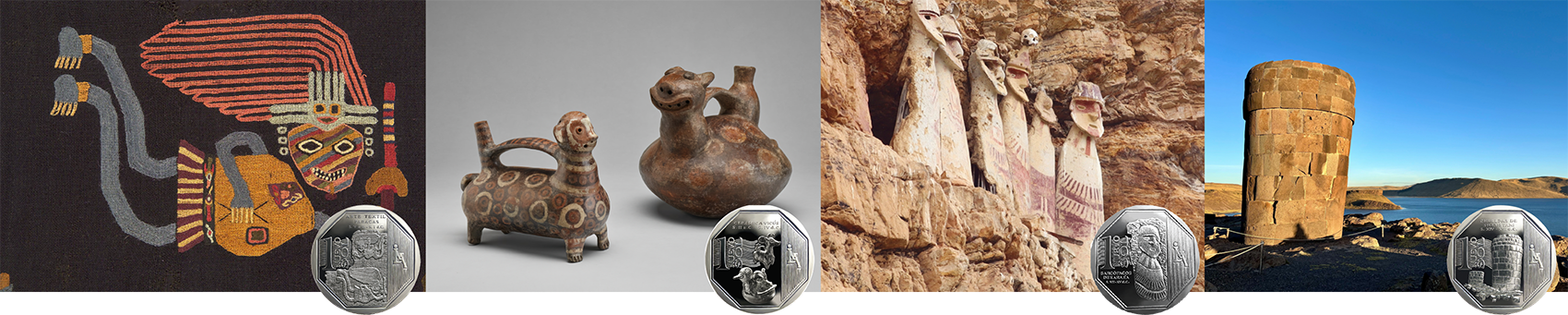
The Preceramic civilisations (c. 3000 – 1800 BC) in the Andes are quite unique in that urban centres with large temple mounds arose long before people made pottery, wove cloth or relied on agropastoral activities. Caral-Supe in the Supe Valley is regarded as the oldest civilisation and urban centre in the Americas.
The following Initial Period (c. 1800 – 200 BC) presents profound changes in terms of subsistence, which was now relying on agricultural staples and domesticated animals, and artefact production. The most famous of the earliest Peruvian civilisations, the Chavín, united communities from the coast to the highlands. They produced impressive monuments and introduced metallurgical innovations, including alloying gold with silver and copper. At the same period, rich grave goods at several places, including the ceremonial centre of Kuntur Wasi in the sierra and Paracas on the coast, point to the fact that social changes were underway.
During the Intermediate period (c. 200 BC – AD 650), governance in the sierra highlands and along the desert coast was at the hands of well-established elites. The Moche produced the most acclaimed art style to arise in the desert valleys of the north. They also erected significant mound monuments, such as the Huaca del Sol and the Huaca de la Luna. Partially contemporary with the Moche was the vibrant Nazca culture, which also produced impressive ceramics and textiles maintaining the earlier Paracas polychrome tradition.
In the Middle Horizon (c. AD 650 – 1000) the political antecedents of the later Inca imperium gradually arose. The empires of the Wari in the north and Tiwuanaku in the south were both militant, centralised and hierarchical, while also presenting affinities in crafts and iconography. At Tiwuanaku the ruling elite erected imposing temple mounds, including the largest platform mound in the southern Andes, for ritual display. The Wari built a large city near Ayacucho, which thrived for around 300 years.
During the Late Intermediate Period (1000-1476), the Chimu empire ruled from the city of Chan Chan, probably the largest adobe city in the world, and consolidated much of the desert coast. This was south America’s second largest Native empire. The Sicán (Lambayeque), who built adobe pyramids, were Chimu’s biggest coastal opponents after the Moche’s policy dissolved.
Between AD 1200-1400 many small kingdoms apperared in the Andean highlands. Nevertheless, only two presented the sociopolitical complexity of the coastal empires. These were the Chachapoyas, who built large fortresses and cities in the San Martin region, and the Incas at the Cusco region.